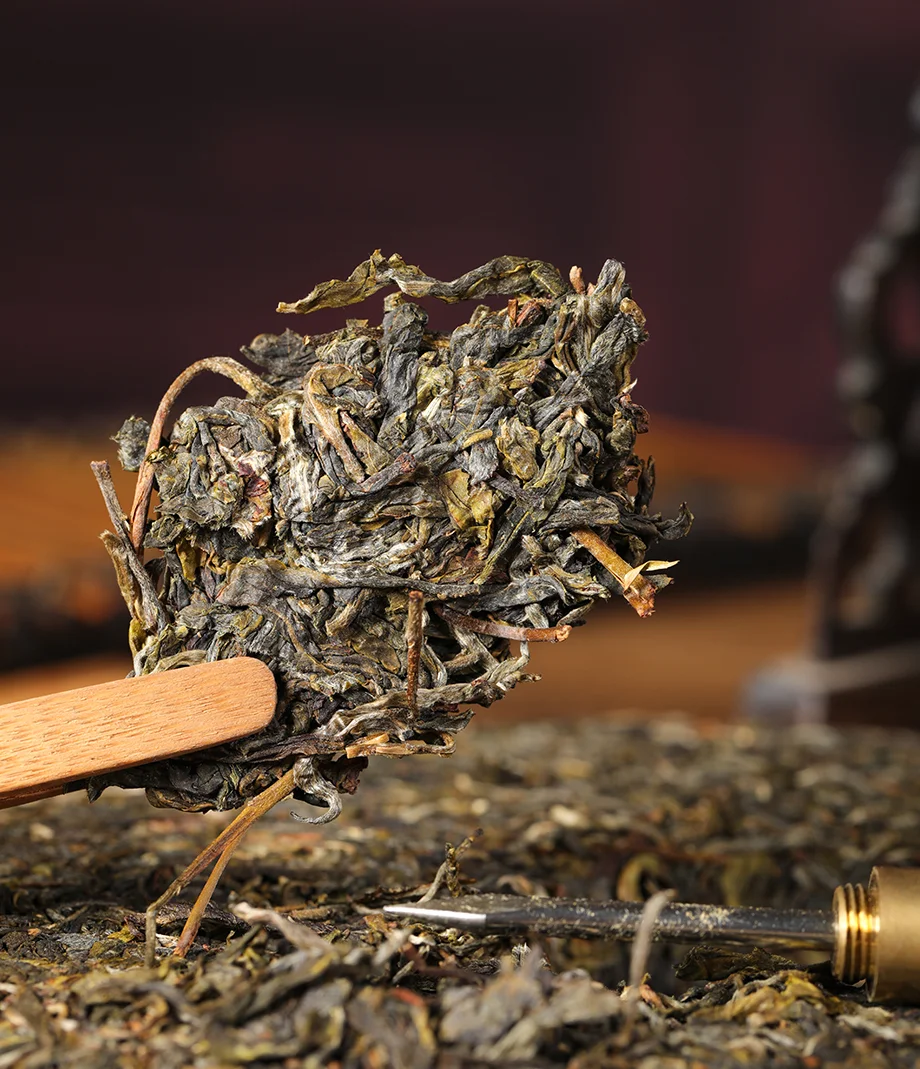

A traditional 357g pu-erh cake carries the same odd number on every wrapper, from every mountain in Yunnan. 357 grams reads like a rounding error, and the number is deliberate.
The 357g pu-erh cake exists because the cake is one seventh of a stack. Seven cakes wrapped together in bamboo leaf make a tong, and 7 cakes at 357 grams comes to 2,499 grams, which is 2.5 kilograms, or 5 jin in the Chinese weight system still used across Yunnan today. Twelve tong fill a bamboo basket at 29,988 grams, near enough to 30 kilograms. Two baskets balance across a pack animal at roughly 60 kilograms. The weight of the cake follows from the weight of the load.
357 grams is one seventh of a stack
Every unit above the cake is round. Only the cake itself carries the remainder.
| Unit | Contains | Weight |
|---|---|---|
| Cake (bing) | 1 cake | 357 g |
| Tong | 7 cakes | 2,499 g, about 2.5 kg or 5 jin |
| Jian (basket) | 12 tong, 84 cakes | 29,988 g, about 30 kg |
| Animal load | 2 jian | about 60 kg |
Nobody in the trade counted single cakes. Tea moved by the tong and was taxed by the basket. A merchant quoted you a stack, a caravan driver loaded two baskets, and the cake was what you got when you divided the stack seven ways. The 7 grams left over at the top of the tong are the residue of that division.
Qi zi bing cha means seven sons cake tea
Wrappers still carry the name of the format, qi zi bing cha, seven sons cake tea. Seven is the count that sets every other weight in the system.
Seven carries weight as an auspicious number, and a tong of seven cakes reads as a wish for a full family, many sons and many blessings. A stack given as a gift said something a single cake could not. That symbolism is why the tong holds 7 rather than 6 or 8, and because the tong holds 7, the cake holds 357 grams.
The standard was built around what a mule could carry
Pu-erh is compressed because loose leaf is bulky, fragile, and impossible to count without unwrapping it. Pressed cakes survive months on a mule and can be tallied by sight.
Under the Qing dynasty, regulation of the Yunnan tea trade fixed the seven-cake tong as the standard unit so tea could be counted, taxed, and transported without being opened. The caravans of the Ancient Tea Horse Road, the Chamagudao, carried it out of Pu-erh City toward Sichuan, Tibet, and the border markets. 30 kilograms a side is what a mule carries over mountain trails for weeks at a time. Load it heavier and the animal gives out before the tea reaches a market.
Those mountains still supply the best raw material. Our own raw pu-erh is pressed from Jingmai Mountain and Bangwai Mountain in Yunnan, and the ancient tea gardens of Jingmai sit inside the same landscape that set this standard, on trees more than a hundred years old.
Metrication kept the number instead of rounding it
China standardized on metric weights in the 1950s. This was the obvious moment to tidy the cake up to 350 grams or 400 grams, and the state tea factories declined.
They declined because the trade did not price cakes. It priced tong and jian. Contracts, warehouse ledgers, and references to older vintages were all denominated in stacks and baskets. Rounding the cake would have changed the weight of every unit above it and broken continuity with decades of records. Keeping 357 grams cost nothing.
So Qing-era caravan arithmetic survived into a metric supply chain, and it is still printed on the wrapper.
The tong also still sets prices. Aged pu-erh trades by the stack, and an intact tong of 7 cakes in its original bamboo-leaf wrapper sells for more than 7 separate cakes of the same tea and vintage. The wrapper is the provenance. It shows the cakes were stored together, in one place, under one set of conditions, and were never split for resale. A full jian of 84 cakes carries a further premium for the same reason. Anyone buying aged cake for storage rather than for drinking is buying that continuity, which is why the 357 gram unit still shapes a market that no longer moves tea by mule.
Not every pu-erh is 357 grams
The traditional standard applies to the round cake, and it applies to ripe pu-erh as much as to raw. Outside that format the weights vary freely. Round cakes are also pressed at 100 g, 200 g, 250 g and 400 g. Mini cakes usually run 50 g to 100 g, a modern format with no historical unit behind it. Bricks (zhuan) and bowls (tuo) follow their own conventions, usually 100 g to 250 g.
When a seller offers a 357 gram cake, they are signalling the traditional pressing. When they offer 200 grams, they are making a product decision. The leaf can be equally good either way, and the difference is how much of it you are committing to.
What a 357g pu-erh cake gives you in the cup
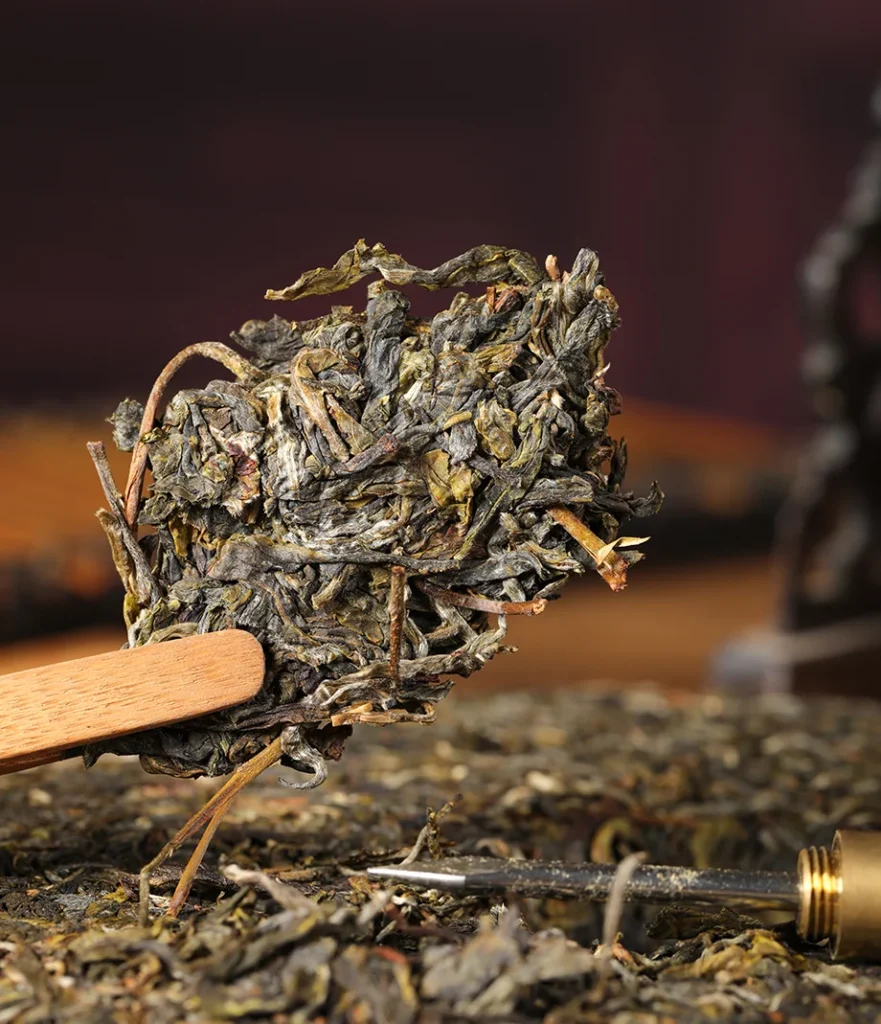
357 grams is 12.6 ounces of compressed leaf.
At our gongfu ratio of 5 to 7 grams per 100 ml, a single cake gives roughly 50 to 70 sessions, and each of those sessions runs 8 or more infusions. Brewed western style at 3 to 4 grams per mug, the same cake is closer to 90 to 110 cups. Buy one in spring, brew it twice a week, and it will last most of a year.
A traditional cake commits you to a single tea from a single mountain for several years, and it will not taste at the end of that time the way it did at the start. Compressed leaf ages slowly and evenly, which is the entire point of pressing it, so how you store the cake matters as much as how you brew it.
Buy a mini cake before you commit to 357 grams
A 357g pu-erh cake of a tea you turn out not to like is a long mistake.
This is why we press the same leaf both ways. Jingmai Mountain and Bangwai Mountain are both available as modern mini cakes alongside the traditional pressings. Meet the tea at mini-cake scale, brew it four or five times across a few weeks, and find out whether you want to spend a year with it.
If you already know the answer, take the full cake. The Jingmai traditional 357 g pressing is the one to start with for bright, apricot-edged raw pu-erh from century-old trees, brewed at 96°C to 100°C in a gaiwan or a Yixing pot. The Bangwai traditional 357 g cake is the other side of Yunnan and rewards a direct comparison.
Browse the pu-erh collection to see both formats of both mountains, or read how much caffeine is in pu-erh before you decide how often a cake that size will actually get brewed.