
Green tea antioxidants are mostly catechins, a family of polyphenols that fresh tea leaf contains. EGCG (epigallocatechin gallate) is the most abundant of them.[1] Because green tea is the least oxidized of the major tea types, its leaf keeps more of these compounds intact than black tea does.
However, most articles skip the kettle. How hot your water is and how long the leaf sits in it change how much catechin ends up in the cup, and they change how the tea tastes.
What the antioxidants in green tea are
Catechins are the main group. You will see four named most often: EGC, ECG, EC, and EGCG. EGCG leads by quantity, and it also gives young green tea its dry, slightly astringent grip.
In laboratory settings, tea catechins scavenge reactive oxygen species effectively.[1] That is a chemistry result, though. What it means for a person drinking tea is a narrower question, and we answer it below.
What the evidence says about drinking it
The body metabolizes catechins rapidly. Studies show that drinking tea produces modest, short-lived increases in the antioxidant capacity of blood plasma.[1] Evidence on long-term health outcomes in humans is mixed, so we do not claim green tea treats or prevents any condition.
Still, green tea is a good source of catechins, and the amount in your cup depends on how you brew it. If you are curious about the other active compound in the leaf, our guide to green tea caffeine covers the same brewing levers from the caffeine side.
Water temperature and steep time decide how much you extract
A 2015 study in the Journal of Food Science and Technology brewed green tea at 75°C, 85°C, and 95°C for anywhere from 1 to 45 minutes and measured catechins in each cup.[2] The results help anyone who brews at home:
- 85°C for 3 minutes gave the highest EGCG, 50.69 mg per 100 ml, and the best sensory scores.
- 95°C peaked sooner. EGCG topped out at 2 minutes (40.92 mg per 100 ml) and then fell.
- Longer steeps past the peak lost catechin content because the compounds converted to other forms, and the cup turned darker and more bitter.
In other words, more time and more heat do not mean more antioxidants. The catechin peak sits close to where the tea tastes best, so a clock and a thermometer serve you better than a rolling boil.
Why Chinese green tea keeps its catechins
Catechins break down when the leaf oxidizes, and Chinese green tea is made to prevent that. Within hours of picking, producers heat the leaf in a dry wok or pan, which deactivates the enzymes that drive oxidation. Producers call this step sha qing, or fixing the green. Farmers pan-fire Longjing by hand, which gives the flat leaf its toasted chestnut edge. Oolong and black teas skip or delay this step on purpose, so their catechins convert into other compounds.
This also explains the 70°C to 80°C guidance. Because the leaf is already fixed, it needs less heat to release what it holds.
How to brew our green teas
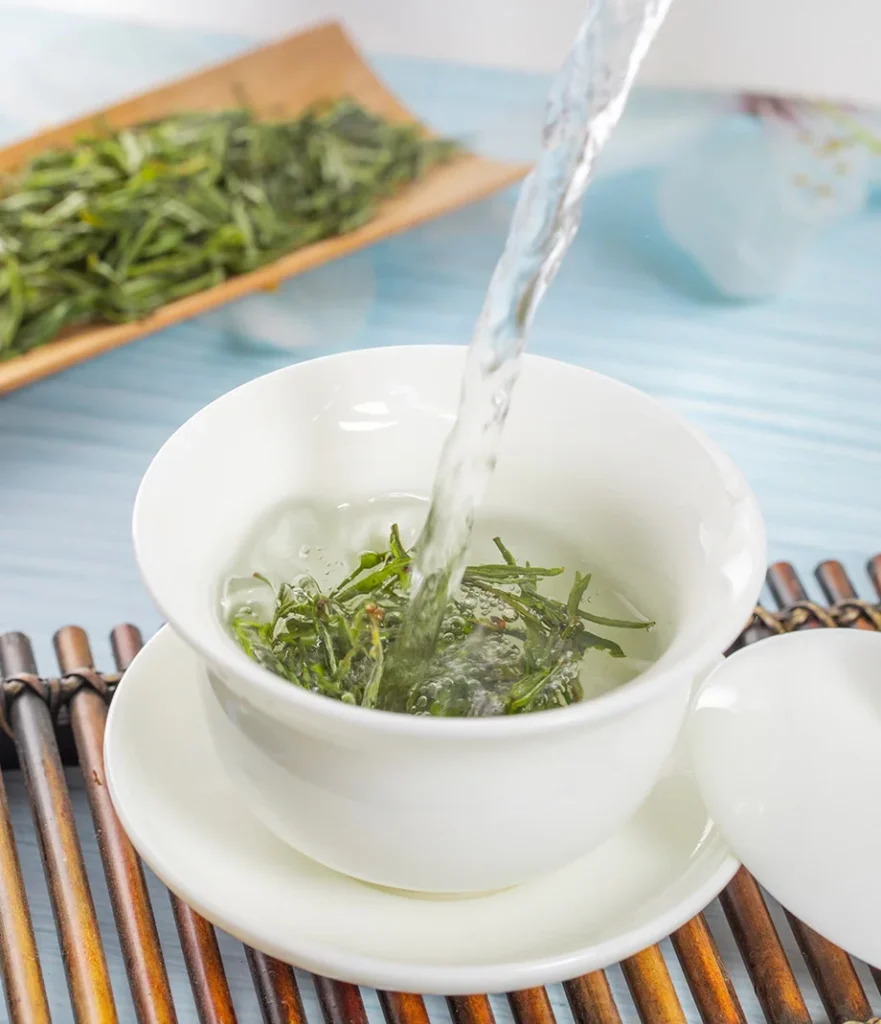
Every green tea we carry comes from China, and each prefers water between 70°C and 80°C (158°F to 176°F). That range sits just under the 85°C peak in the study, which suits fine, tender leaf that bruises easily. Use the table as a starting point, then adjust to taste.
| Tea | Origin | Water | Vessel |
|---|---|---|---|
| West Lake Longjing | Hangzhou, Zhejiang | 70°C to 80°C | Gaiwan, glass, or porcelain pot |
| Dongting Biluochun | Suzhou, Jiangsu | 70°C to 80°C | Glass or porcelain pot |
| Huangshan Maofeng | Huangshan, Anhui | 70°C to 80°C | Gaiwan, glass, or porcelain pot |
Start with about 3 grams of leaf per 200 ml of water and a steep of 2 to 3 minutes. Pour all of the tea off the leaf each time, so nothing keeps extracting in the pot. If you brew in a gaiwan, our walkthrough on how to use a gaiwan shows the pour. A gaiwan makes short, repeatable steeps easy.
Why spring leaf and leaf grade matter
Pickers harvest all three of our green teas in early spring, around the Qingming Festival, when the buds are small and young. West Lake Longjing takes about 60,000 buds to make 1 kilo of tea. Young leaf gives a sweeter, less bitter cup at lower brewing temperatures.
Biluochun also shows white down on its leaf. That fine hair signals tender, early picking, and it is part of why the cup tastes fruity and floral. We cover how makers produce it in the craft of Biluochun.
Where to start
If you want a first green tea to brew for its catechins and its flavor, take West Lake Longjing: toasted chestnut and fresh-cut grass, forgiving at 80°C. For a floral, fruity cup, choose Biluochun. Finally, Huangshan Maofeng is the mild one, with no astringency, so it works as an everyday tea.
Browse the full green tea collection, and brew at 80°C for 2 to 3 minutes.