
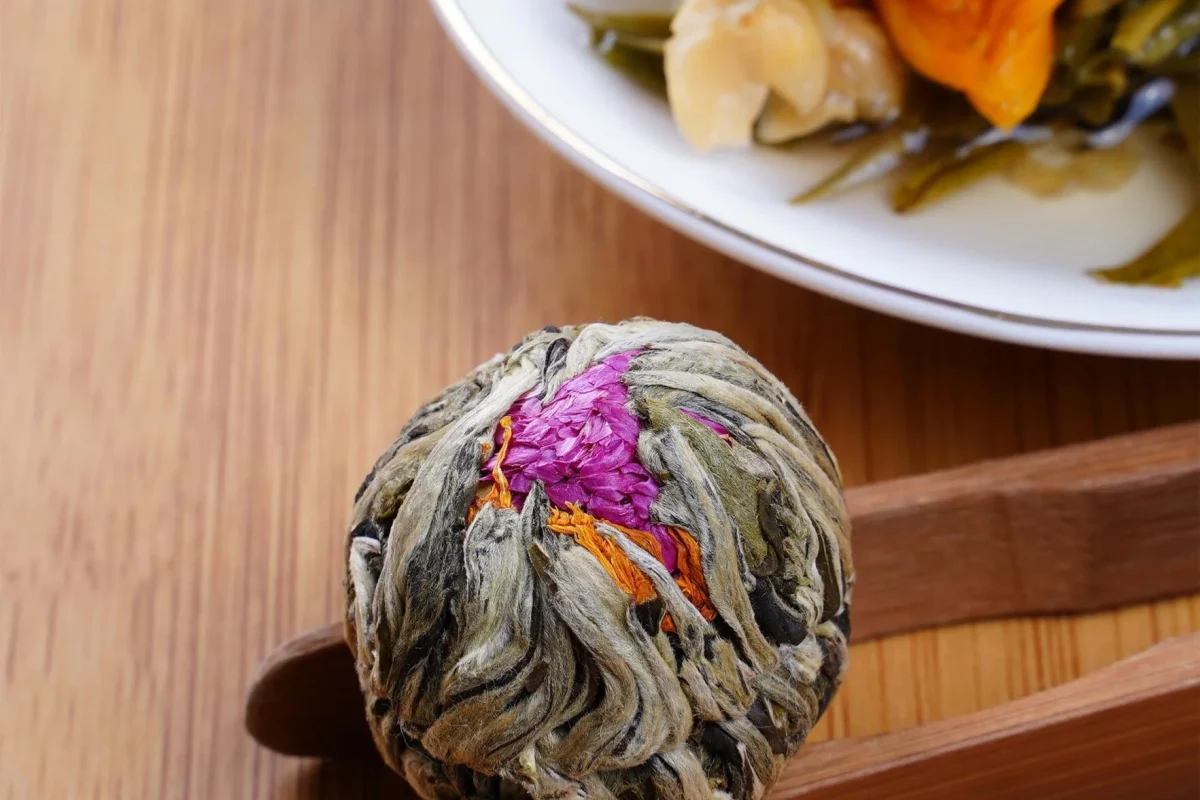
Drop a small dry bundle into a glass pot, pour hot water over it, and watch. Over the next few minutes the bundle swells, the outer leaves fall open, and flowers appear at the center where a moment ago there was nothing but tightly wound green tea. That is a blooming tea, and a Jasmine Fairy is one of the most recognizable versions of it.
Blooming tea, also called artisan tea or flowering tea, is whole green tea leaves hand-tied around real flowers into a compact bundle. It is a relatively recent craft in tea’s long history, developed in China in the 1980s specifically to turn the act of brewing into something you watch happen. Our Jasmine Fairies are bundles of dried green tea leaves wrapped around jasmine flowers, marigold, and globe amaranth, sourced from Huangshan, Anhui Province.
How it is actually made
A tea artisan starts with whole, high-quality green tea leaves rather than the broken leaf used in most loose tea. The leaves are folded around a core of dried flowers and hand-stitched or hand-tied into a tight bundle, most often a rounded ball or a compact cone shape. Done well, the leaves hold their shape completely dry and open only when they meet water.
That handwork is the reason blooming teas cost more per serving than plain loose leaf: each bundle is one person’s work, not a machine process. A single bundle is sized to be brewed once, as a small performance in a glass pot, rather than portioned out cup by cup the way a bag of loose tea is.
What happens when you brew it
Use a tall glass or a glass teapot, not an opaque one. The visual is the entire point, and a closed or ceramic vessel hides it.
| Setting | Value |
|---|---|
| Water temperature | 158°F to 176°F (70°C to 80°C) |
| Vessel | Tall glass or glass teapot |
| Bundle | 1 whole bundle per pot or large glass |
| First infusion | 3 to 5 minutes, until fully open |
Pour water in slowly and watch the outer leaves loosen first. Over the next few minutes, the bundle unfurls fully and the flowers at the center become visible, usually a marigold or amaranth bloom framed by jasmine. The liquor itself is light: green tea with a gentle floral lift from the jasmine, closer to a delicate green than to a heavily scented jasmine tea. A single bundle can usually be re-steeped once or twice more, each infusion lighter than the last.
Not just jasmine
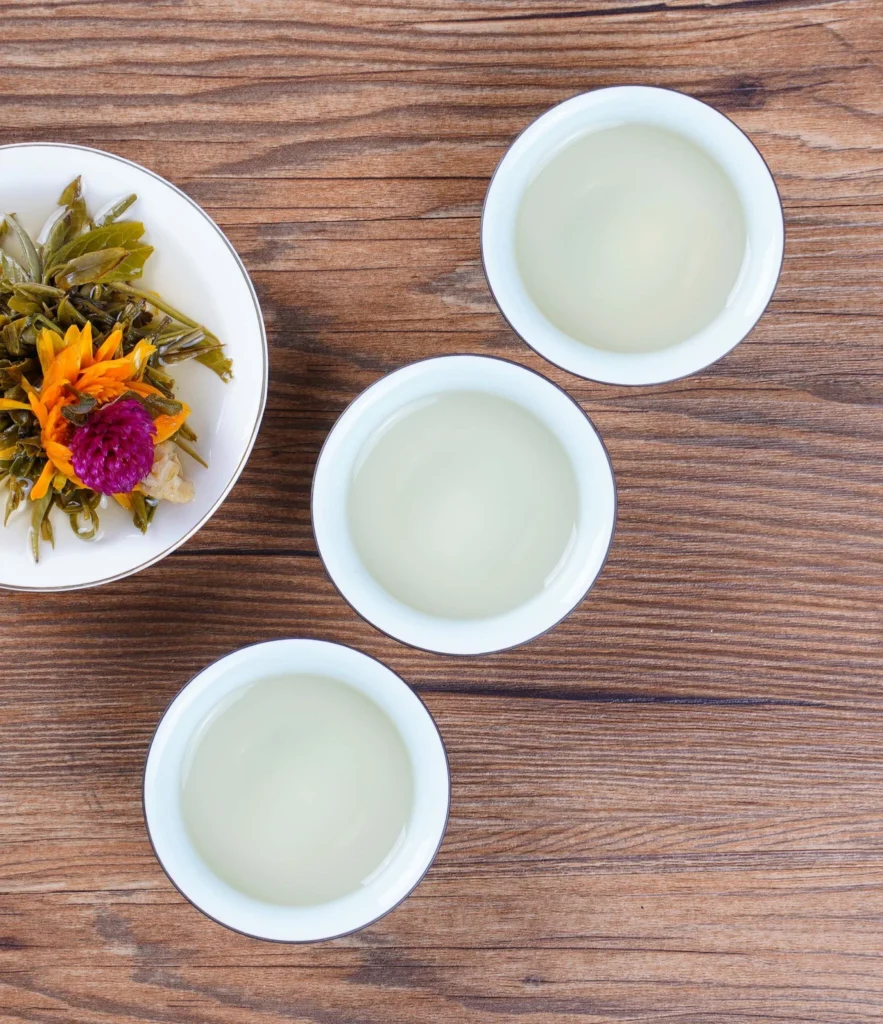
Jasmine is the most familiar flower in blooming tea, but it is not the only one used. Chrysanthemum, lily, hibiscus, and osmanthus all appear in the wider category, each bundle built around whichever flower the artisan is working with. What stays consistent across all of them is the technique: whole leaf, hand-tied, brewed to open rather than to be strained and discarded after one steep.
Common mistakes
Using water that is too hot. Blooming tea is built on green tea leaf, which scorches easily. Water above 176°F (80°C) will open the bundle faster, but it also cooks the leaf and pulls out bitterness instead of the gentle sweetness the tea is meant to have. Slower and cooler is correct here, not a shortcut being skipped.
Brewing it in a small cup. A bundle needs room to expand fully. Dropped into a narrow mug, the outer leaves have nowhere to go and the flower at the center may never fully clear the leaf around it. A tall glass or a wide glass teapot gives the bundle the space the unfurling actually needs.
Treating it like a strong tea. Because a whole bundle looks substantial dry, it is easy to expect a bold cup. What you get instead is a light, green-tea-based liquor with a soft floral note. That is not a weaker version of a normal tea, it is what a correctly brewed blooming tea is supposed to taste like.
Who it is for
A blooming tea is not really an everyday-drinking tea, in the way a bag of oolong or black tea is. It is closer to a small ritual: something you brew when you have a few minutes to actually watch it, or something you set in front of a guest because the moment it opens does more to hold attention than any amount of description could. That also makes it a natural gift. A Jasmine Fairy photographs well before it is ever brewed, and it does the rest of the work itself the first time someone pours hot water over it.
It pairs naturally with the rest of our flower tea collection, for anyone assembling a gift set or building out a lighter, caffeine-moderate rotation alongside stronger teas.
Buying it
Look at the bundle itself before buying: it should be tightly and neatly tied, with visible structure, not a loose clump of leaf fragments. A well-made bundle holds together completely dry and only comes apart in water. Expect a light, floral cup rather than a strong one. Blooming tea’s appeal is visual and gentle, not bold, and judging it by the strength of a black tea will leave you disappointed in the wrong thing.
Start with the Jasmine Fairies, brewed in glass the first time so you can watch the whole thing happen.