
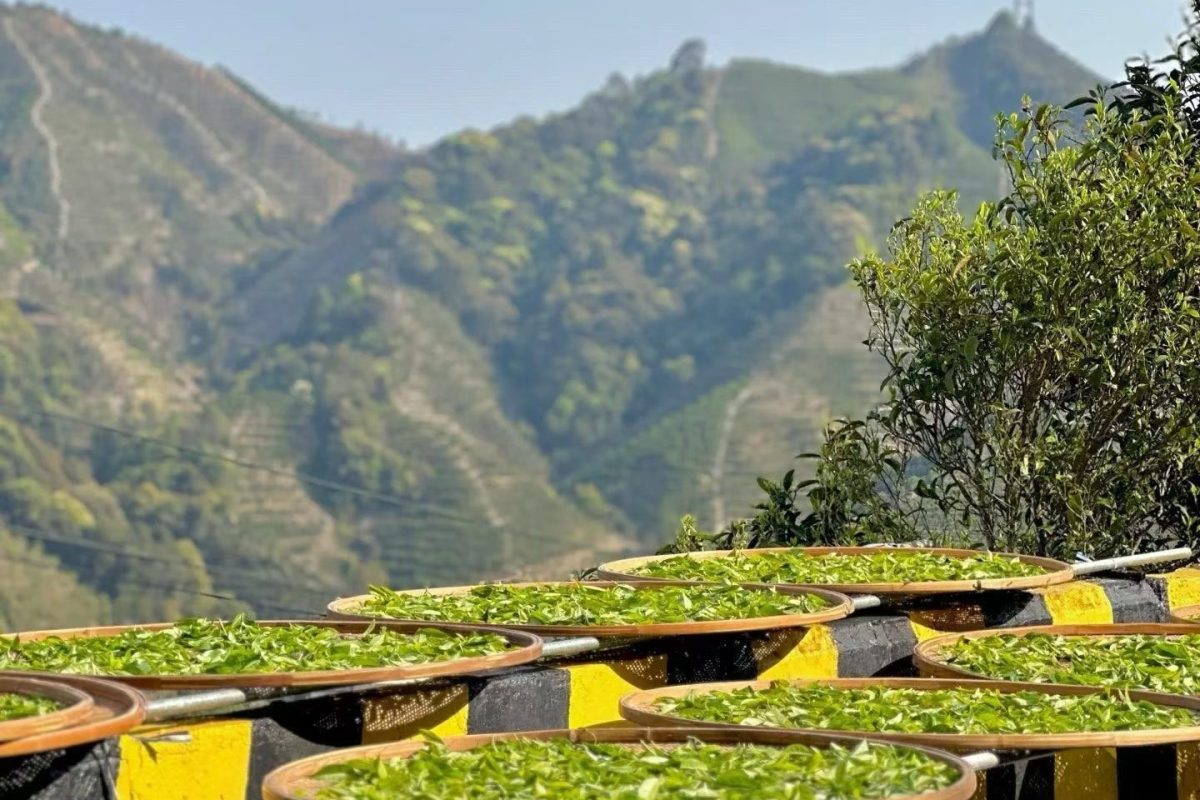
The first thing the mountain gave us was its vertical scale.
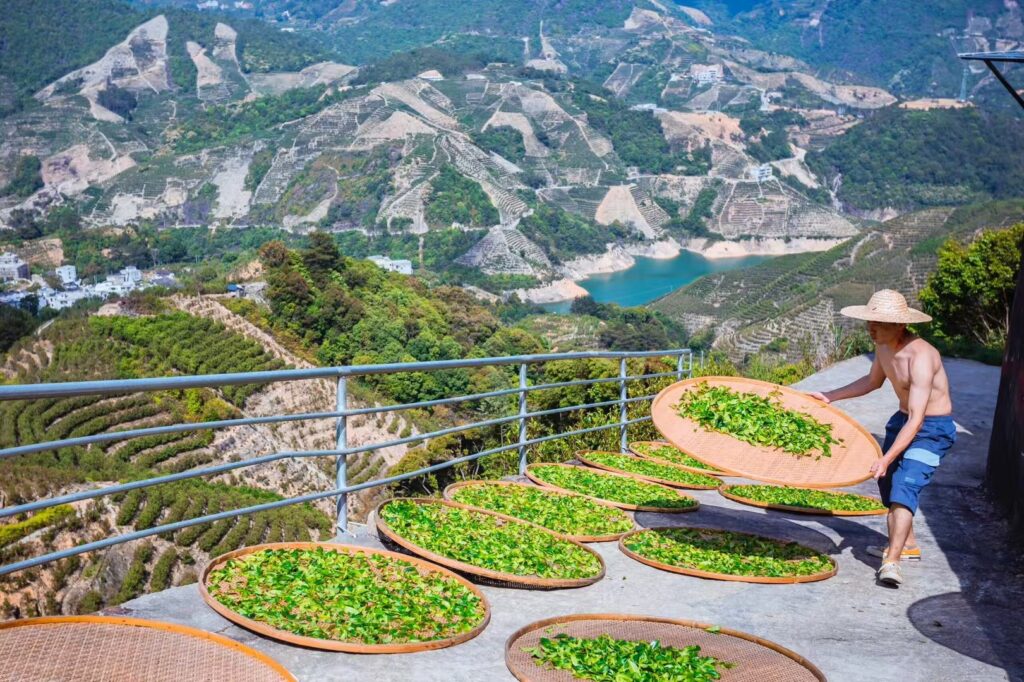
From an overlook above Wu Dong village, the terraced tea fields cascaded down sun-lit ridges toward a small village of white-walled houses, gathered on a saddle, with a turquoise reservoir held in the cleft below. Cleared contour terraces alternated with forested ridges all the way to the horizon. That landscape, equal parts cultivated and wild, is the working canvas of Feng Huang Dan Cong. It is also the first piece of evidence in any honest conversation about provenance.
Producers across the Chaoshan region make tea in the Dan Cong style. Only the leaf grown on this specific mountain earns the name Feng Huang Dan Cong.
A tea with a creation myth
The mountain’s tea identity is grounded in the mythology of the She, the ethnic group that has lived on these slopes for centuries. The She trace their lineage to a mythical ancestor named Pan Hu, a dragon who transformed into a dog-headed human. In the story, Pan Hu’s brother, known as Black Dragon, or Wu Long, became a vine that caused Pan Hu’s death, and then, in remorse, transformed into a tea tree to provide for his descendants.
The lore matters for two reasons. It situates oolong’s origin as a tree, not a processing category. And it locates that tree on Feng Huang Shan, not in any of the regions that later carried oolong knowledge north. Some She communities did migrate, into Fujian, Zhejiang, and Anhui, taking the craft with them. About 260 She people still live in Feng Huang today, primarily in the village of Shi Gu Ping, where a temple to Pan Hu remains.
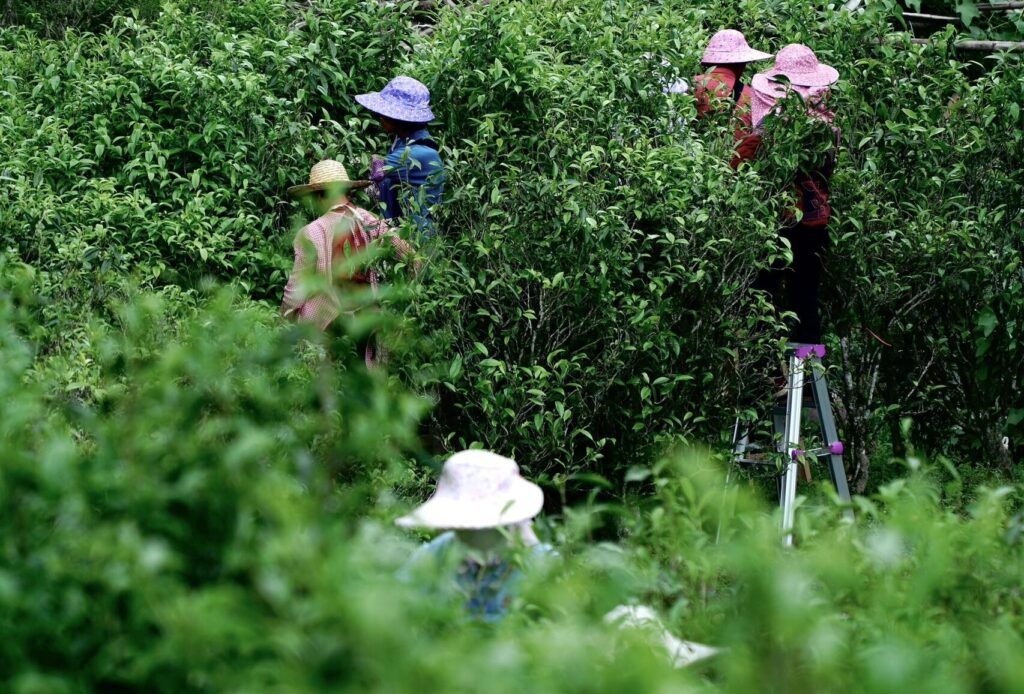
Whether or not the story is taken literally, the geography is unambiguous. Wu Long, the word that became oolong, comes from this mountain.
Reading the landscape
Feng Huang township sits inside Chao Shan, the twin-city region of old Chao Zhou and newer Shan Tou. Nineteen villages cling to the range. The most renowned is Wu Dong, which is both a village and the peak above it, at roughly 4,600 feet.
From the ground, the differences between villages are legible in the terrain itself. On the upper ridges, contoured tea rows wrap around exposed rock and run right up to the foundations of stone homesteads carved into the slope. Isolated white-walled houses sit alone on hillsides laced with hand-cut terraces. Lower down, the slopes flatten into wider managed plantations of contoured bushes and rust-colored soil.
The naming rules follow the terrain closely.
- Only tea from the village at the top of Wu Dong mountain can be labeled Wu Dong tea.
- Villages just below the peak, Ping Keng Tou and Dan Hu among them, sit on the same mountain but produce tea under their own village names.
- Two teas grown only a few hundred meters apart in elevation can therefore carry very different identities, and very different prices.
This is not a marketing convention. It is how the mountain itself is organized.
Feng Huang and Rao Ping
Historically, the city of Rao Ping administered Feng Huang township. That jurisdictional history has direct consequences for sourcing.
Rao Ping is now one of the largest peripheral producers of Dan Cong-style tea in Guangdong. It is also widely identified as a central hub for counterfeit Dan Cong sold under the Feng Huang name. A tea grown in Rao Ping, processed in a Dan Cong style, and labeled “Phoenix Dan Cong” is not technically a lie. It is also not what most drinkers think they are buying.
Verifying that a tea comes from the core township, and ideally from a named village inside it, is the first authenticity filter we apply before any leaf comes home with us. The villages on this mountain are not interchangeable. Feng Huang and Rao Ping are not interchangeable. A label that says only “Phoenix Dan Cong” answers almost none of the questions that matter.
What this looks like in practice
Before any leaf comes home with us, we trace it back to the village it grew in. The village does not always appear on the product page. Farm relationships are the work of years, and the granularity that protects them stays in our hands rather than on the public catalog. What does reach the page is a leaf we have personally walked the slopes for.
The mountain is doing the work. Our job is to read it correctly and report what we found.
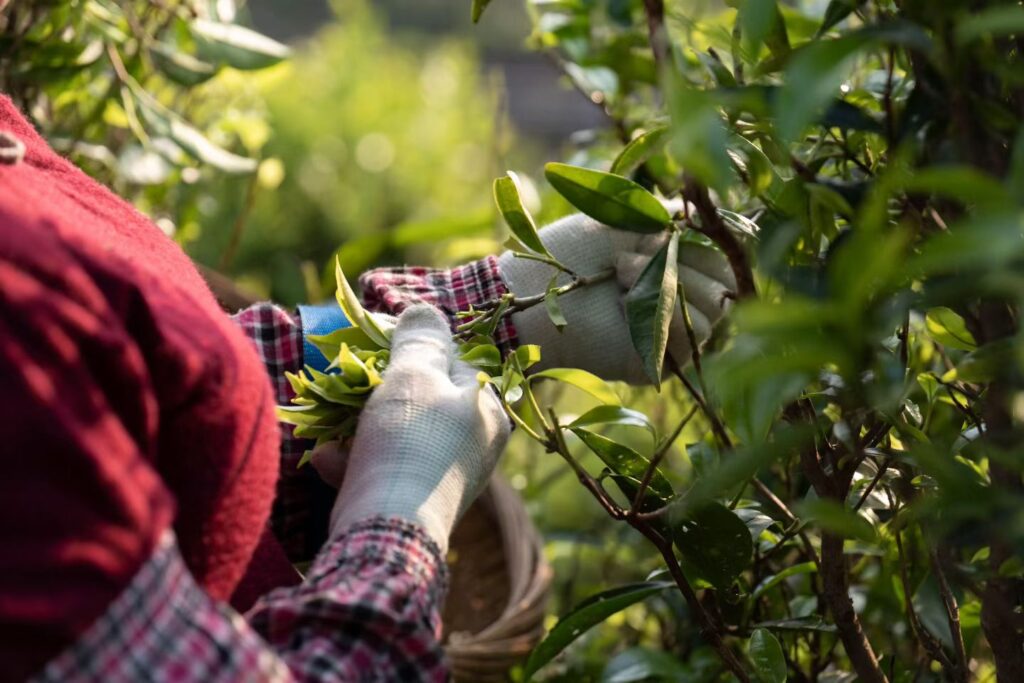
If you want to follow the rest of the trip, the original Phoenix Mountain journey post walks through the processing side of the visit. The two companion notes from this trip, on the old trees above the village and on the harvest calendar that keeps Dan Cong off the market until late summer, pick up where this one leaves off.
The Dan Cong we currently carry from this mountain sits inside the oolong collection. The named-village teas, starting with Mi Lan Xiang and Ya Shi Xiang, are the ones that carry the most of the mountain in the cup.